Most PDRN content focuses on individual products. This one is about the system.
A single PDRN serum applied over a harsh cleanser, underneath a heavy fragrance cream, with no SPF to follow, will underperform. The ingredient works — but it works inside a routine architecture. Get the architecture right, and you are compounding the regenerative effect of every layer. Get it wrong, and you are neutralizing products against each other.
This is the routine we would build if we were starting from scratch in 2026, knowing everything the research now shows about how PDRN interacts with its neighboring ingredients.
The logic behind the layering order
Before the product list, the principle: PDRN works at physiological pH (approximately 5.5–6.5), requires direct skin contact before any occlusive layer, and its mechanism — adenosine A2A receptor activation — is enhanced rather than disrupted by niacinamide, hyaluronic acid, and peptides.
The standard Korean skincare layering rule (thinnest to thickest, water-based before oil-based) applies, with one PDRN-specific addition: never apply PDRN on top of a facial oil or heavy balm. The active needs to reach skin surface receptors directly. Occlusive layers go after, not before.
For cleansing: PDRN is rebuilding the barrier. A sulfate-heavy cleanser that strips lipids is actively working against that process every morning and evening. A low-pH, non-stripping cleanser is not optional — it is the foundation that makes everything above it work.
The 7-step routine
Step 1 — Cleanser
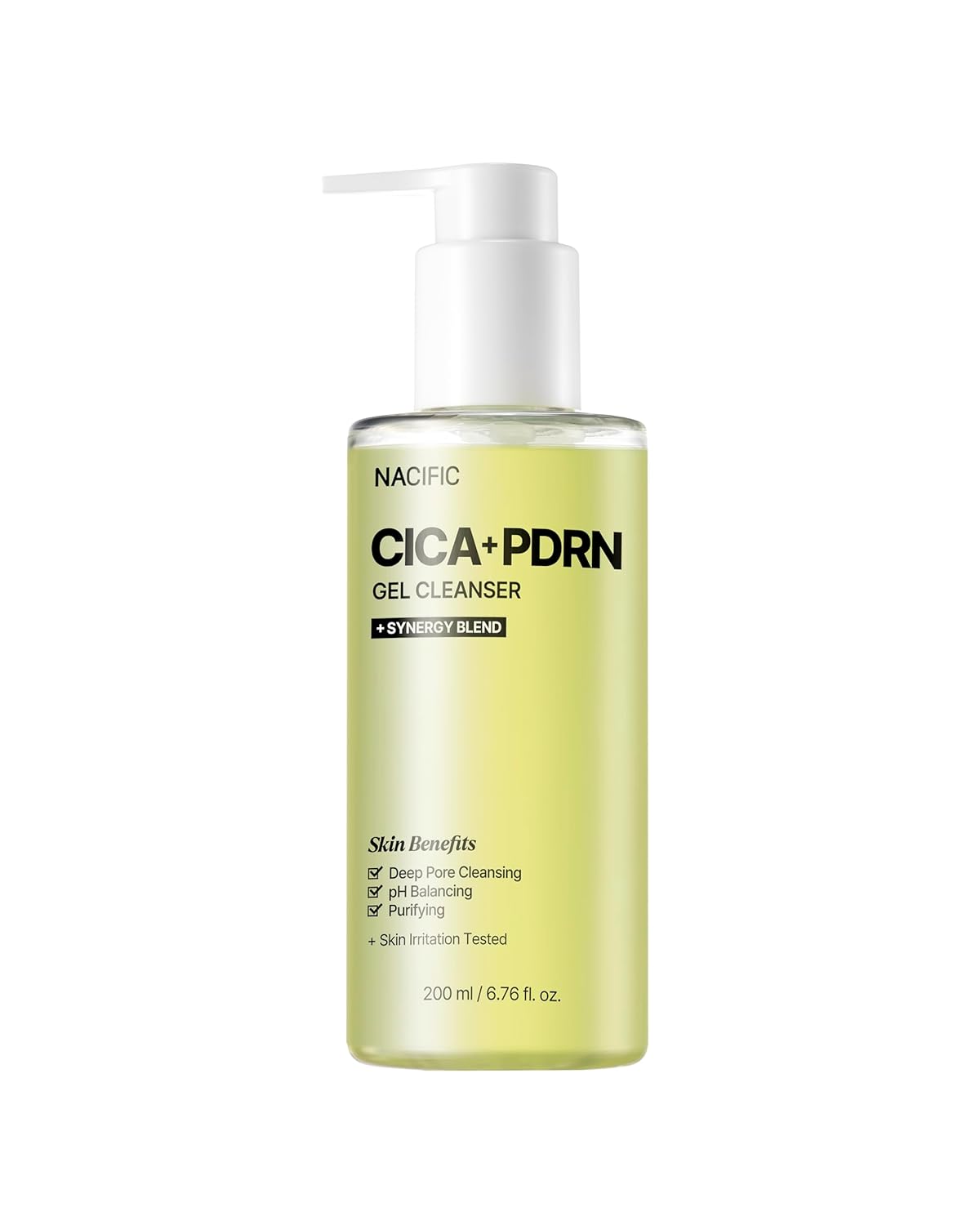
NACIFIC Cica PDRN Gel Cleanser
Starting with PDRN in the cleansing step matters more than most routines acknowledge. The NACIFIC cleanser pairs PDRN fragments with Centella Asiatica (cica) in a gel format that maintains a skin-compatible pH and does not strip the moisture barrier. You finish cleansing with skin that is calm, balanced, and ready to absorb what comes next — not tight, dry, or reactive.
The cica combination specifically targets the inflammation cycle: centella inhibits collagen breakdown via matrix metalloproteinase suppression while PDRN activates the repair pathway. Even in the rinse-off step, you are setting an anti-inflammatory tone for the rest of the routine.
At approximately $13–18 for 200ml, it is also the best-value product in this lineup by a significant margin.
Step 2 — Toner
Medicube PDRN Pink Niacinamide Milky Toner
Apply to damp skin immediately after cleansing. The milky format is the key feature: unlike watery toners that evaporate before absorption, the lipid-rich base creates a brief occlusive window that drives PDRN fragments closer to the epidermis before the next step is applied.
The niacinamide co-ingredient does something important here: it begins reinforcing tight junctions in the epidermis (barrier function) while PDRN is activating the A2A receptor cascade beneath. These are complementary mechanisms running in parallel, not competing. A 2022 PMC-indexed study confirmed that niacinamide and PDRN together reduce melanogenesis more effectively than either alone — a useful finding for anyone using this routine to address uneven tone alongside anti-aging goals.
Apply with palms, press gently rather than swiping. Wait 20–30 seconds before the next step.
Step 3 — Essence
VT Cosmetics PDRN 100 Essence
The essence step exists to maximize concentration before the serum. VT’s PDRN 100 Essence is a minimalist formula — salmon PDRN at high concentration, centella asiatica, allantoin, and nothing else. No niacinamide, no peptides, no vitamin C. Just PDRN in a thin, watery base that absorbs in seconds and stacks invisibly.
Why add this when you already have PDRN in the toner? Because the toner’s milky format means some of its PDRN is held in the lipid base and releases slowly. The VT Essence delivers an immediate high-concentration PDRN dose directly to skin surface before the serum step amplifies it further. You are layering the same mechanism in multiple formats — which the clinical literature on topical PDRN consistently shows produces better outcomes than a single high-concentration application.
Three to four drops, patted in gently. Skin should look dewy rather than wet before moving on.
Step 4 — Serum
Medicube PDRN Pink Peptide Serum
The concentrated active layer. Medicube pairs PDRN with matrikine peptides (palmitoyl oligopeptide and palmitoyl tetrapeptide-7) here, creating two simultaneous collagen synthesis signals: PDRN via adenosine A2A receptor activation, peptides via direct fibroblast communication. The downstream effect is the same — collagen and elastin production — but the pathways are independent. Running them in parallel at the serum step is the highest-leverage thing you can do in this routine for structural skin improvement.
Apply three to four drops, press into skin with flat palms rather than rubbing. The serum absorbs within 30 seconds on normal skin; slightly longer on very dry skin. Do not skip this step in the morning.
Step 5 — Eye area
Medicube PDRN Eye Serum
The periorbital zone has thinner skin, lower sebaceous gland density, and reduced structural support compared to the rest of the face. It is also where PDRN’s regenerative effects tend to be most visibly apparent — the barrier is easier to reach, the inflammatory signals that cause puffiness and dark circles (particularly vascular pooling types) are directly addressed by PDRN’s anti-inflammatory cascade, and fine lines respond to collagen synthesis activation relatively quickly in this zone.
Apply with ring fingers — gentlest finger, lowest pressure — tapping along the orbital bone from inner to outer corner. Do not pull. The skin here does not bounce back from repeated mechanical stress.
Step 6 — Moisturizer
Anua PDRN Hyaluronic Acid 100 Moisturizing Cream
The moisturizer step seals everything beneath it while adding its own active layer. Anua’s PDRN cream does this intelligently: salmon PDRN continues the regenerative signal while eight molecular weights of hyaluronic acid create a moisture gradient from the surface down. Low-molecular-weight HA fractions penetrate toward the dermal-epidermal junction; high-molecular-weight HA sits at the surface and forms a breathable film.
The cream is lighter than its “moisturizer” classification suggests — it absorbs cleanly without the greasy finish that makes people skip this step in the morning. At 80,000+ purchases per month on Amazon, the consensus is clear. Apply a pea-to-five-pence sized amount, warm between palms, and press rather than rub.
Step 7 — SPF (morning only)
Beauty of Joseon Relief Sun: Rice + Probiotics SPF50+ PA++++
PDRN’s regenerative work happens primarily overnight and in the hours after application. UV radiation is the single biggest accelerant of the inflammation and oxidative damage PDRN is repairing. Skipping SPF after a four-product PDRN stack is the equivalent of rebuilding a wall and then taking a hammer to it.
The Beauty of Joseon Relief Sun is the standard recommendation for PDRN routines for specific reasons: it uses an organic (chemical) filter system that leaves no white cast, its probiotic and rice bran base is actively compatible with the barrier-repair work PDRN is doing, and the dewy finish photographs and wears well over the hydration this routine creates. PA++++ is the highest UVA protection rating — essential for preventing the photoaging that undoes collagen synthesis gains.
Apply as the final morning step, generously, to all exposed skin.
Morning vs evening: what changes
Morning (all 7 steps): Cleanser → Toner → Essence → Serum → Eye → Moisturizer → SPF
Evening (steps 1–6, no SPF): Cleanser → Toner → Essence → Serum → Eye → Moisturizer
In the evening, you can optionally add a sleeping mask as a final occlusive layer over the moisturizer. A ceramide-based or centella-based sleeping mask adds nothing new mechanically but extends the occlusive window overnight, which increases the time PDRN’s downstream effects can proceed without environmental disruption.
Ingredient compatibility: the full picture
| Pairing | Verdict | Notes |
|---|---|---|
| PDRN + Niacinamide | ✓ Synergistic | Combined, reduces melanogenesis more than either alone |
| PDRN + Peptides | ✓ Additive | Independent collagen pathways — no competition |
| PDRN + Hyaluronic acid | ✓ Synergistic | HA hydrates the environment PDRN repairs |
| PDRN + Vitamin C | ✓ Compatible with sequencing | Apply vitamin C first; wait 1–2 min for pH to normalize |
| PDRN + Retinol | ✓ Compatible | PDRN buffers retinol irritation; use alternating evenings if sensitive |
| PDRN + AHA/BHA (high conc.) | ⚠ Alternate | Exfoliating acids disrupt the barrier PDRN is rebuilding |
| PDRN over facial oil | ✗ Avoid | PDRN needs direct skin contact; never apply over occlusives |
What to expect and when
Weeks 1–2: Hydration improvement first. The layered HA and beta-glucan produces noticeable plumping within days. Reactive skin typically calms — less stinging from other products, reduced tightness after washing.
Weeks 3–4: Barrier function consolidates. Skin reacts less dramatically to temperature, wind, and other actives. This is PDRN’s anti-inflammatory effect establishing itself systemically rather than topically.
Weeks 6–8: Texture and tone changes become apparent. Pore appearance tightens, PIE from old breakouts fades noticeably faster, and fine-line depth begins to reduce. These are structural changes driven by collagen synthesis activation.
Weeks 8–12: The full PDRN picture. A quality of light and resilience that comes from genuinely improved barrier integrity and dermal collagen density. Before/after photos taken at the 12-week mark consistently show the most compelling results in this timeframe.
The full system costs roughly $100–130 for first-time setup. Each product lasts between 6–10 weeks at twice-daily use, making the per-day cost approximately $0.80–1.20 — competitive with any single-product clinical facial active at equivalent quality.
The short version
If you only have room for three products from this list: the Medicube Milky Toner (toner + first active in one), the Medicube Peptide Serum (concentrated dual-mechanism repair), and the Beauty of Joseon SPF (protect what you are building). Add the others as budget allows. Start with SPF if you own nothing else.